Equine-Assisted Psychotherapy (EAP/EAT)
Incorporating horses and other animals into Counseling Sessions


Our Herd
Our program is supported by a unique herd of horses who live and work together in a relationship-centered, at-liberty environment. Rather than being trained to perform tasks, our horses are encouraged to interact naturally and communicate in ways that are authentic to them.
Each horse in our herd has their own story. Some have experienced neglect or abandonment. Some were once considered unsafe or unmanageable. Some live with chronic pain, fear, or the effects of past trauma. Like people, they carry their own histories—and are actively learning, healing, and adapting over time.
Because of this, their responses are not robotic or conditioned—they are real.
At Liberty: Real Responses, Real Connection
Most sessions take place at liberty, meaning the horses are free to move, engage, or create space as they choose.
They may approach with curiosity, walk away, set boundaries, or simply observe. These responses are not directed or forced—they are genuine expressions of how the horse is experiencing the moment.
Over time, the herd has learned that their communication is noticed and respected. Because they don’t have to escalate to be heard, their signals often become quieter, clearer, and more regulated.
Healing Alongside the Herd
Our horses are not “perfect.”
They are not here to perform.
They are beings who are also learning.
Some are learning how to trust again.
Some are learning how to regulate fear.
Some are discovering how to say “no” after years of compliance.
Within the herd, you can observe the full range of nervous system responses—fight, flight, freeze, and fawn—and how those responses shift over time when safety, space, and relationship are present.
This creates a powerful parallel to human experience.
Clients often begin to recognize their own patterns reflected back:
-
How they approach or avoid connection
-
How they respond to boundaries
-
How their nervous system reacts under stress
-
How regulation and safety can be built over time
How Does This Become Therapy?
Spending time with horses can be meaningful on its own—but equine-assisted psychotherapy is more than simply spending time around horses.
I bring my training as a therapist alongside my knowledge of horses, equine behavior, relationships, and the individual horses who live here. I may share something I'm noticing, explain what may be happening within the herd, tell you a story about a particular horse, ask a question, or invite you to slow down and notice what is happening around you—and within you.
Horses give us a lot to be curious about. They experience fear and safety. They communicate boundaries, respond to pressure, seek connection, navigate relationships, and have individual histories, preferences, and ways of moving through their world.
As we spend time with them, you may begin noticing things about the horses, the environment, relationships, or yourself that are harder to notice when we're simply sitting in an office talking.
There isn't a predetermined lesson we're trying to uncover, and I won't decide what a horse's behavior is supposed to mean for you. Sometimes an experience leads to an important conversation. Sometimes it creates an opportunity to try something differently. Sometimes it simply helps you slow down, become curious, or experience connection in a different way.
The therapy happens in what we notice, explore, experience, and make meaningful together.
Trust, Trauma & Regulation
For individuals whose trust in others has been impacted, horses can provide a different kind of relational experience—one that is grounded in consistency, honesty, and nonverbal communication.
For trauma work, this approach allows for somatic and relational processing without requiring full verbal disclosure. Clients can begin to notice body cues, regulate emotions, and build a sense of safety in the moment.
Comfort & Connection
Horses can also offer quiet comfort during times of grief, anxiety, or overwhelm. Their presence invites slowing down, grounding, and connection—often in ways that feel more accessible than traditional talk therapy alone.
It’s about understanding relationship, communication, and healing—together.
Animal-Assisted Therapy (AAT)
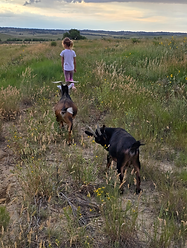
In addition to our horses, therapy dogs and goats may be part of the process.
-
Therapy dogs support emotional regulation, grounding, and comfort
-
Goats offer playful, engaging interactions that encourage expression and reduce stress
These interactions are always guided by a licensed therapist and thoughtfully integrated into the therapeutic process.